

How Professional Content Writing Services Build Helpful, Trustworthy Content for Businesses
Publishing content regularly is easy. Publishing content that people can understand, trust, and use to make a decision is much harder. Many businesses have blogs, service pages, and landing pages, but their content does not always answer the questions customers actually have.
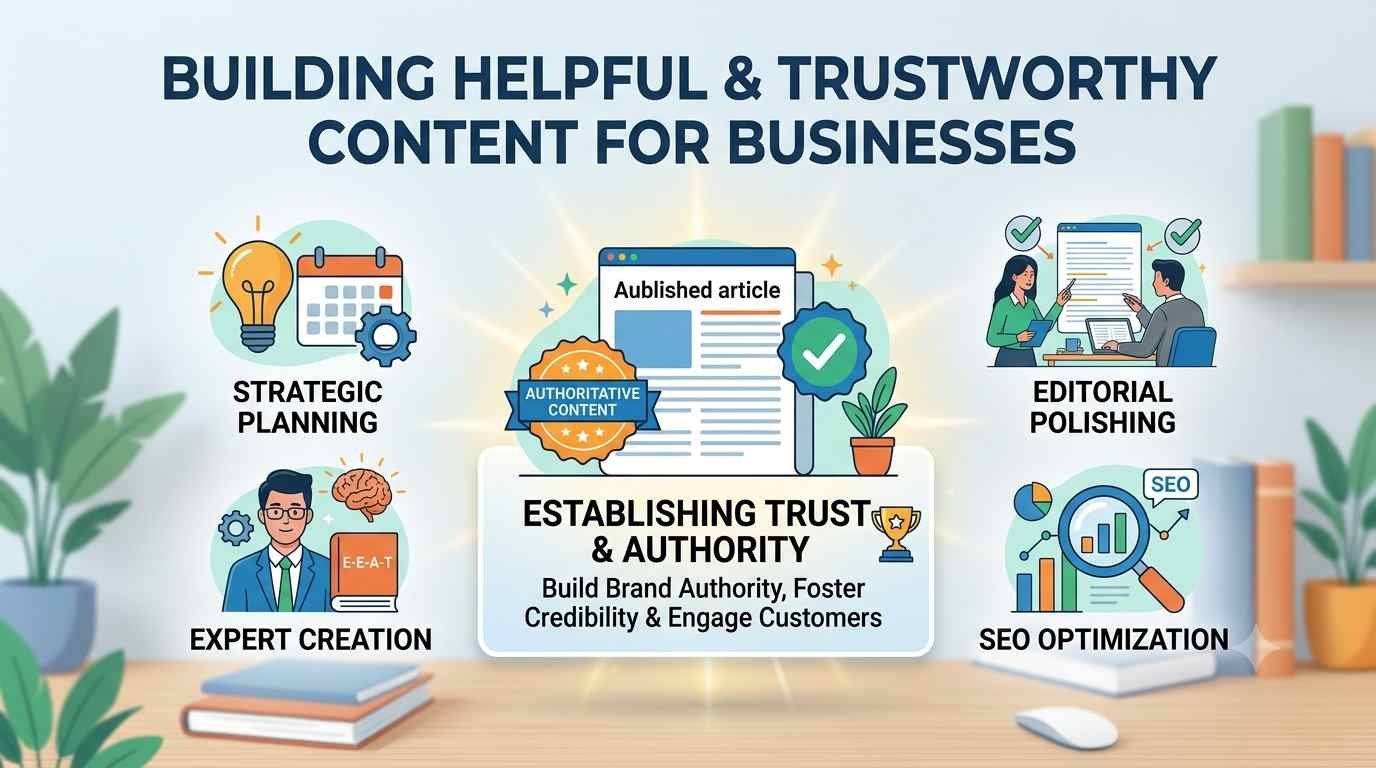
This is where professional content writing services can make a practical difference. A good content team does more than place keywords into paragraphs. It researches the subject, understands the intended audience, checks important information, structures the page logically, and edits the final copy before delivery.
For businesses investing in organic search, these practices also support the principles commonly associated with E-E-A-T: Experience, Expertise, Authoritativeness, and Trustworthiness.
What Does E-E-A-T Mean in Content Writing?
E-E-A-T stands for Experience, Expertise, Authoritativeness, and Trustworthiness. These concepts help describe qualities that can make content more useful and reliable.
Each part addresses a different aspect of content quality:
- Experience: Does the content reflect practical or first-hand experience where experience matters?
- Expertise: Does the writer demonstrate appropriate knowledge of the subject?
- Authoritativeness: Is the content supported by credible information and a clear source or author?
- Trustworthiness: Can readers understand where the information comes from and whether it is reliable?
E-E-A-T is not simply a writing formula. Adding the words “expert” or “experienced” to a page does not automatically make the content trustworthy. The actual content needs to demonstrate these qualities.
Why Experience Matters in Business Content
Readers can often identify when an article has been written only to target a keyword. It may contain general statements but provide little practical information.
Experience can make content more useful.
For example, an article about hiring a content writer can discuss practical considerations such as:
- How to evaluate writing samples
- What information a business should provide to a writer
- Why industry knowledge can affect content quality
- How revisions should be handled
- What should be checked before publishing
- How content briefs can reduce unnecessary revisions
These details come from understanding how content projects actually work rather than simply defining content writing.
For a content writing agency, documenting the workflow, editorial checks, research approach, and common client challenges can help demonstrate genuine experience.
Expertise Should Be Visible in the Content
Expertise is not about using complicated vocabulary. It is about showing that the writer understands the subject well enough to explain it accurately.
A professional content writing team should begin with research before drafting important pages. Depending on the topic, this may include reviewing:
- Official documentation
- Government or regulatory information
- Industry publications
- Primary research
- Reputable company resources
- Subject-matter expert information
- Existing business material supplied by the client
The research depth should also match the topic. A simple lifestyle article does not require the same level of verification as financial, legal, health, or technical content.
This is one reason a professional writing process is more than writing the first draft and sending it to the client.
How a Content Writing Agency Can Improve Content Quality
A structured workflow can reduce common content problems.
At RankWithContent, the content process can be built around several practical stages:
1. Understanding the Brief
Before writing begins, the writer should understand the purpose of the page.
The brief may include the target audience, search intent, business objective, important services, preferred tone, required keywords, word count, and internal linking requirements.
Without this information, even grammatically correct content can miss the actual purpose of the page.
2. Researching the Topic
Research helps the writer identify what information the audience needs.
Instead of relying on assumptions, the writer can review reliable sources and compare information before creating the draft.
For business websites, existing company information should also be considered because the final content needs to accurately represent the business.
3. Creating a Useful Structure
A clear structure allows readers to find information without going through unnecessary paragraphs.
Depending on the topic, a page may use:
- Clear H2 and H3 headings
- Short paragraphs
- Bullet points where appropriate
- Relevant examples
- Direct answers
- FAQs
- Internal links
- Supporting explanations
The structure should follow the user’s information needs rather than forcing every article into the same template.
4. Writing for People First
SEO content still needs to be readable.
Keywords can help search engines understand the subject, but excessive keyword repetition can make a page uncomfortable to read.
For example, instead of repeatedly writing “content writing services” in every paragraph, a writer can naturally use related terms such as content strategy, website copy, blog writing, SEO content, service pages, and editorial content when they genuinely fit the topic.
The goal is to explain the subject clearly while maintaining natural language.
5. Fact Checking Important Information
Accuracy is particularly important when content contains statistics, claims, product specifications, regulations, prices, dates, or technical information.
A professional editorial process should identify information that requires verification before publication.
When appropriate, sources should be cited or linked so readers can understand where important information comes from.
6. Editing Before Delivery
Writing and editing are different stages.
A first draft may contain repetition, weak transitions, unnecessary sentences, inconsistent terminology, or unclear explanations. Editing gives the writer an opportunity to correct these problems.
A useful editorial check can include:
- Grammar and spelling
- Sentence clarity
- Repeated ideas
- Keyword placement
- Heading structure
- Factual consistency
- Search intent
- Internal links
- Readability
- Brand tone
Human-Written Content Needs More Than a Claim
Many businesses now ask whether their website content is human-written. However, simply claiming that content is written by humans does not demonstrate quality.
The more useful question is: Can readers see evidence of careful research, relevant experience, editorial judgment, and useful information?
Human writers can bring context, judgment, interviews, personal observations, industry knowledge, and original explanations to a topic. These elements can make content more useful when they are genuinely relevant.
At the same time, human-written content can still be inaccurate or poorly researched. Human authorship alone is therefore not a substitute for editorial quality.
E-E-A-T and SEO Content Are Not Separate Goals
Businesses sometimes treat SEO and useful writing as two different objectives.
In practice, a well-structured page can address both.
An SEO content writer may consider:
- What users are searching for
- The likely search intent
- Important questions around the topic
- Relevant terminology
- Page structure
- Internal linking opportunities
- Clear explanations
- Original and useful information
The SEO component helps the page communicate its subject clearly to search systems, while the content itself should provide genuine value to the reader.
Why Author Information Can Matter
For many topics, readers want to know who created the information.
A suitable author bio can provide useful context about the writer’s relevant experience or area of expertise. For specialist topics, businesses may also use subject-matter experts to review content before publication.
An author bio should be factual. It should describe real experience rather than using exaggerated claims simply to create an appearance of authority.
For example, a content writing agency can introduce its writers, editors, and relevant professional experience where appropriate.
Originality Is More Than Passing a Plagiarism Check
Original content does not simply mean that the words are different from another website.
A page can be technically plagiarism-free and still provide nothing new.
Useful originality can come from:
- Practical examples
- Original explanations
- Industry observations
- First-hand experiences
- Unique comparisons
- Expert interviews
- Business-specific information
- Clear answers to overlooked questions
This is particularly important for service businesses because generic information may not explain why a particular process, service, or approach is relevant to their customers.
How Businesses Can Evaluate a Content Writing Agency
Before hiring a content writing agency, businesses can look beyond word count and price.
Ask questions such as:
Who will write the content?
Understand whether the agency uses dedicated writers, editors, subject specialists, or a mixed workflow.
How is research conducted?
Ask how the team handles factual information and industry-specific topics.
Is there an editing process?
Find out whether another person reviews the content before delivery.
Can the writer follow brand guidelines?
A good article should sound appropriate for the business rather than like a generic template.
How are revisions handled?
Clear revision terms can prevent confusion after the first draft.
Can the agency provide relevant samples?
Samples from similar industries can help you assess whether the team understands your type of audience and content requirements.
What Makes Content Trustworthy?
Trust is built through details.
A trustworthy business page should make it reasonably clear:
- Who is providing the service
- What the service includes
- What information is based on research
- What claims can be supported
- How customers can contact the business
- What limitations or conditions apply
Content should also avoid making claims that cannot be supported.
For example, statements such as “guaranteed #1 rankings” or “100% guaranteed traffic” require particular caution because search performance depends on many external factors.
Clear communication is generally more useful than exaggerated promises.
A Practical E-E-A-T Checklist for Website Content
Before publishing an important page, businesses can review it using a simple checklist.
Experience
- Does the page contain practical information?
- Does it reflect genuine experience where relevant?
- Are examples specific rather than generic?
Expertise
- Has the topic been properly researched?
- Are technical claims accurate?
- Is the information appropriate for the intended audience?
Authoritativeness
- Is the author or business clearly identified?
- Are important claims supported by credible sources?
- Does the website provide useful supporting information?
Trustworthiness
- Is the information transparent?
- Are claims realistic?
- Is contact and business information clear?
- Has the content been reviewed before publication?
This checklist does not guarantee search visibility. It is simply a practical way to review whether content is useful, credible, and responsibly produced.
How RankWithContent Approaches Business Content
RankWithContent focuses on creating content that is written around the actual purpose of a business page rather than producing paragraphs simply to reach a word count.
The process can include topic research, content planning, SEO considerations, drafting, editing, and final quality checks. The level of research can also be adjusted according to the subject and the information required.
For service pages, the focus is on explaining what the business offers, who it serves, how the service works, and what customers should know before making contact.
For blogs, the structure is developed around the reader’s questions and search intent.
The objective is straightforward: create content that a real person can understand and use.
Final Thoughts
E-E-A-T is not something that can be added to a website through a few keywords or a standard author bio. Stronger signals come from the quality of the information, the credibility of the sources, the relevance of the writer’s experience, and the transparency of the business.
Professional content writing services can support these areas through research, structured writing, fact checking, editing, and clear communication.
For businesses, the most useful content is usually the content that answers real questions, explains important details clearly, and gives readers enough reliable information to understand their next step.
Need Content That Represents Your Business Properly?
If your website has outdated pages, thin service content, poorly structured blogs, or content that does not clearly communicate your offering, simply publishing more articles may not solve the problem.
RankWithContent can help you turn those requirements into clear, researched, and reader-focused content.
Share your topic, website, target audience, or content requirement with our team. We can discuss the scope, required content type, word count, and delivery requirements before the project begins.
Looking for a content writing agency that focuses on research, readability, SEO, and editorial quality? Start your conversation with RankWithContent today.